
Noble Plastics kicked off 2023 with the first official announcement for our turnkey IMM Tending System. Scott Rogers, our Technical Director, spoke with Matthew Naitove of Plastics Technology to discuss why this product was important to develop.
I fear nothing. For all is as the Force wills it.
-Chirrut Îmwe Rogue One: A Star Wars Story
A simple statement in a galaxy far, far away and a simple truth in injection molding. So much so that Noble utilizes an array of in-mold sensors to help troubleshoot and monitor the molding process.
These cavity pressure sensors give us ‘force sensitive’ insights.
An injection molding machine will monitor machine-specific process outputs such as injection pressure, screw position, barrel temperatures, etc., allowing a basic level of process control. However, the actual conditions within the mold remain mysterious. Pressure and temperature sensors can give insight into the actual conditions of the plastic as the part is being molded – giving a greater level of understanding and control of the molding process.
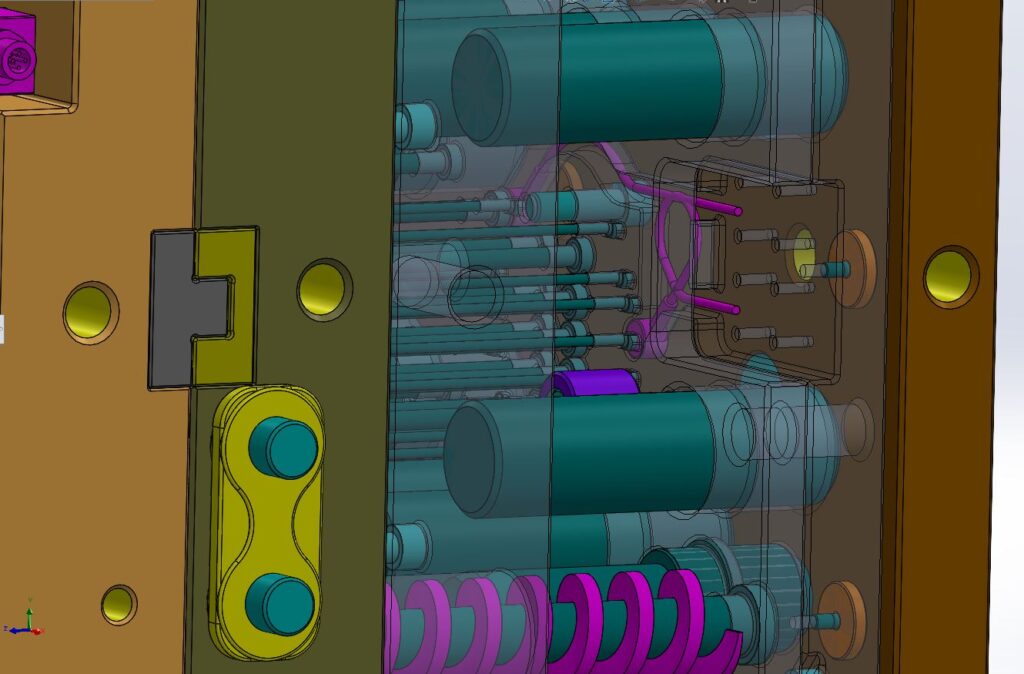
The sensors can be placed strategically within the mold to monitor conditions at points of interest. Pressure sensors are often placed behind ejector pins or standing core pins near the gate or at the end-of-fill. You can see how the sensors (purple) sit behind the ejector pins (blue) in the image below. Using both a post-gate and end-of-fill sensor together allows for insights into information such as effective viscosity and pressure drop across the cavity. Thermocouples can be placed in temperature critical or sensitive areas in the mold to monitor hot spots or give insight into controlling shrinkage.
Data is stored as a process template, ensuring consistency of operation between production runs, lots of material, and moves between molding machines. This reduces product variance and increases startup efficiency.
Sensors are often included in the initial design of a mold but can also be retrofitted into existing tooling. The added benefits and increased level of control often offset the burden of installation. To learn about how to incorporate sensors in your mold, contact our sales team today!
MORE N-SIGHTS™
The Benefits of Virtual Molding Software
Virtual molding software is an invaluable tool for streamlining the injection molding process and ensuring product quality.
Noble Plastics Announces OnRobot Distributor Partnership
Noble Plastics is excited to announce that we are officially an OnRobot partner. Well known in the collaborative end of arm tooling space, OnRobot provides pre-engineered hardware and software that facilitates quick, simple, and effective implementations for many applications.
Join Our Conversation
SUBCRIBE TO NOBLE INSIGHTS